


Twelve Essential Steps to Net Zero Energy Video
Highline Park Fly-Through Animation Design Video
Highline Park NYC Video


If you have or know a solar project, please submit it to us for consideration as a featured project using Submit an Item. http://www.solaripedia.com/302/submit-an-item.html


Project
Plantagon Vertical Farm
Credits: ©2009 Karen Cilento/Arch Daily
by Karen Cilento/ArchDaily
We have shared architects’ different approaches to addressing the pressing food issue, from the highly conceptual designs to the more classical ideas. It seems that more competitions and clients require architects to implement gardens for harvesting food, or create an available food solution to accompany the structure. Statistics estimate that more than 80% of the population will live in cities by 2050 and the oil transportation needed to ship food from rural areas will only become more expensive. Soon, adding alternative farming methods won’t be an option; it will be a necessity if food for cities is to remain cost-efficient.
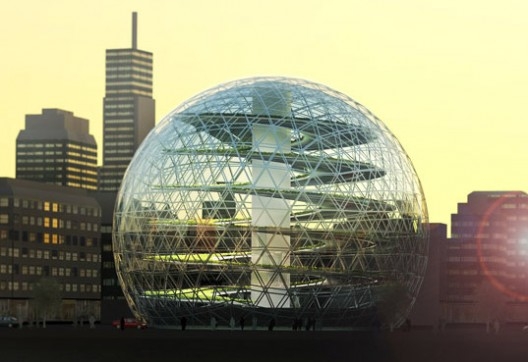
Plantagon's take on the vertical farm idea: a geodesic dome containing an urban Plantagon® greenhouse. ©2009 SWECO


Plantagon, a Swedish-American company, has recently created their take on the vertical farm idea: a geodesic dome containing an urban Plantagon® greenhouse. The farm “will dramatically change the way we produce organic and functional food. It allows us to produce ecological with clean air and water inside urban environments, even major cities, cutting costs and environmental damage by eliminating transportation and deliver directly to consumers,” explained Plantagon.
As the images illustrated, Plantagon envisions major cities adopting their greenhouse solution. The project features a large spiraling ramp that will provide the necessary space for food growth and production. The glass dome covering the ramped space will provide the necessary light needed to nurture the gardens. Since the glass is curved, varying amounts of sunlight will penetrate according to the angle of incidence.
The company is presently working with Sweco, a consulting engineering firm, to calculate how much sun will reach the interior ramps as the seasons and the sun’s position in the sky change. “It has been a considerable challenge for us at Sweco. Our goal has been to find technical solutions that make it possible to grow crops with high quality and good operating economy,” stated Stephan Stålered, a consultant at Sweco. While a lot of areas still need to be figured out, Plantagon hopes to have the first farm fully functioning within 3 years.
Resources

