

Highline Park NYC Video
Highline Park Fly-Through Animation Design Video
Highline Park Design Video


If you have or know a solar project, please submit it to us for consideration as a featured project using Submit an Item. http://www.solaripedia.com/302/submit-an-item.html


Project
Mountlake Terrace Transit Center (USA)
Credits: ©2010 Community Transit
It seems like a good time to revisit the Mountlake Terrace Transit Center near Seattle that recently achieved a Green Globes green building certification for its five-level parking structure. It is significant that this uninhabited building could even achieve a certification as other rating programs exempt parking structures from their programs. Green Globes, however, takes the approach that all buildings, no matter their uses, could qualify as a green building. In the case of the Mountlake Transit Center, it is not simply a parking deck but rather a park-and-ride for commuters. Ten electric vehicle charging stations were also recently installed there. In a process that began in 2007, Green Globes - a web-enabled, fully interactive green building assessment tool in the U.S. - enabled the design team to augment their design, and rate the building’s proposed or actual sustainability performance during all phases of construction. Green Globes requires that 35 percent of its 1000 points be achieved. Its energy criteria are compared against the US DOE’s Commercial Building Energy Consumption Survey (CBECS) that is conducted every four years on actual building data (and is now back in business after budget cuts, according to the US Energy Information Administration). Green Globes forms the basis for the national green building standard for commercial buildings, officially named ANSI/GBI 01-2010: Green Building Assessment Protocol for Commercial Buildings. The Green Building Initiative (GBI) that administers Green Globes, provides a third-party assessor to conduct an on-site building audit, the only rating program that does so. Green Globes places an emphasis on benchmarking and improvements, and can reportedly be completed for a fraction of the combined hard/soft costs and time associated with other rating programs – without sacrificing on sustainability. Green Globes is ideal for complex or specialty buildings that cannot be certified with LEED. (Scroll down for more information and additional resources)
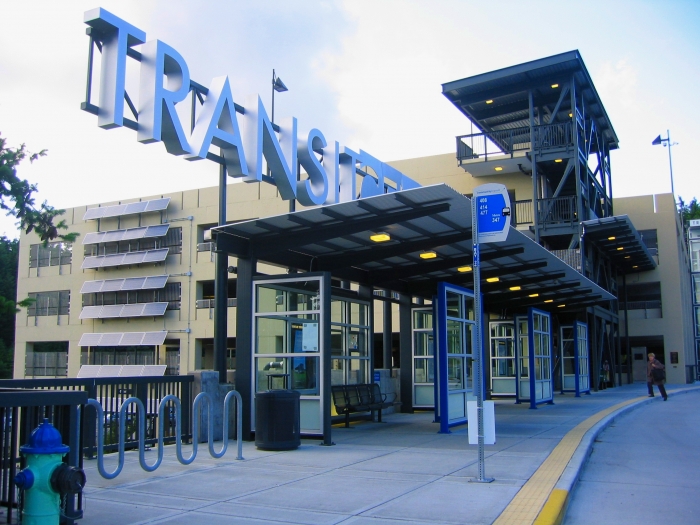
Community Transit isought a green building rating for the Mountlake Terrace Transit Center structure near Seattle in Snohomish County. In March 2012, sing the Green Globes system, it became one of the few, if not the first, uninhabited structures in the world to be rated as a commercial “green” building. ©2010 R. Rogers


Read about Green Globes USA
The Mountlake Terrace Transit Center near Seattle Certified as a Green Building
By Robin Rogers, Solaripedia - Community Transit (CT) is the main public transit authority in Snohomish County, Washington, providing bus and vanpool services for about 40,000 passengers per day. Environmental stewardship is one of the agency’s core values so it was only natural to create a “green” park-and-ride structure for commuters. CT’s big, green ambitions prompted construction of the Mountlake Terrace Transit Center facility, completed in 2009 and perched next to Interstate 5, just north of Seattle. Besides low impact site development, recycled-content materials, and energy-efficient lighting, the south side of the building is outfitted with photovoltaics that offset about 7,700 lbs of CO2 per year. An I-5 flyer stop is under construction in the freeway median west of the transit center, with a pedestrian bridge to the parking garage that will further speed up commuters’ access.
One of Community Transit’s goals is to help reduce single occupant vehicles on the roads. If one person switches to public transit, it can reduce daily carbon emissions by 20 pounds - or more than 4,800 pounds in a year. One commuter who switches to public transportation can reduce a household’s carbon emissions by 10 percent and up to 30 percent if a second commuter car is eliminated. One way to do this, of course, is to provide easy-to-use public transportation that is accessible to the local population. One of CT’s solutions is the Mountlake Terrace Transit Center parking garage and surface lots that have room for up to 880 vehicles.
CT believes there’s additional benefit to Snohomish County because, according to the American Public Transportation Association, every dollar that communities invest in public transportation generates six dollars in economic returns. The average household spends 18 cents of every dollar on transportation, mainly on cars. However, households that use public transportation on a given day can save more than $8,400 annually. With more than 11.8 million passenger trips in 2008, this translates into a lot of money for the Community Transit community that covers 1,305 square miles. (A cost effectiveness evaluation and a cost-benefit analysis on a park-and-ride system in the Seattle metropolitan area indicated that they are cost effective - 11.6 percent less expensive than the corresponding average previous trip by another mode.)
CT’s responsibility to Snohomish County extends beyond the monetary and into the environmental, and that’s one reason this park-and-ride structure was designed and built according to “green” building principles. They started with an integrated team approach during design development, including collaboration among the owner, architects, engineers, consultants, public and stakeholders. And a Commissioning Plan, including construction documentation, was developed and followed throughout construction to ensure that all systems operate as designed.
ENERGY
With the push to reduce fossil fuel use, using renewable energy for this facility became a sort of no-brainer to CT’s design team. Photovoltaic solar panels and a public video display were designed into the project. The solar system includes 32 Schott 170-watt modules. Each module is about 2.5' x 5'. The total array is rated to output 5440 watts under peak sun conditions. The panels are estimated to generate 5500 kWh per year. This will offset 7,700 lbs of CO2 per year and is enough to run two energy efficient homes.
LIGHTING
The Transit Center uses energy-efficient lighting fixtures, lamps, ballasts, HVAC equipment, controls and elevators, including: T5HO energy-efficient lamps and fixtures in the garage; indirect lighting design, with the garage ceiling painted white for maximum reflectivity; LED lighting recessed into stair handrails and the pedestrian bridge; motion sensors in the garage to allow lighting to be reduced during non-operational times; lighting controls by microprocessor and both time and photo sensors, to minimize use of lighting during available daylight; metal halide exterior lighting with long lamp life and low lumen depreciation; and pulse starters on all exterior lighting. In addition, the lighting is designed to minimize light "trespass" to adjacent properties.
MATERIALS
CT utilized recycled materials such as concrete with approximately 15 percent flyash, steel and aluminum products. Low-maintenance and high-durability materials were chosen and the building is designed to allow for future expansion.
SITE
The Transit Center was designed on an existing developed site, which minimized ecological impacts. Minimal trees were removed for construction of the five-level structure, and the project reduced storm-water run-off with increased pervious surface area. The existing underground storm drain - which was a creek before the I-5 freeway was installed - was daylighted into a "Mountain Creek" for aesthetics and aerobic benefits to the water. All native landscaping was installed. TESC plans, Emergency Response Plans, an Environmental Management Program, and Site-Specific Health and Safety Programs were all utilized in the construction contract to protect the site during construction.
SECURITY
To help protect the community and riders, security features were designed into this Transit Center using CPTED principles (Crime Prevention through Environmental Design). A collaborative effort was used with stakeholders such as design professionals, interested community participants, local police, fire department, county sheriffs, and a professional CPTED trainer. The design incorporated specific lighting, landscaping, public art, security cameras and open features to minimize hiding places and increase user safety and enjoyment. The result is minimal vandalism and a high level of customer satisfaction.
AESTHETICS
The building was designed with community involvement for quality appearance and architectural and public art features with custom colors, screening, landscaping, art and walkway, glass elevators and comfortable shelters.
OPERATIONS
CT operations also include an environmentally-friendly approach to almost every aspect of the transit company, not just in this facility. From reducing hazardous waste generation by 99 percent to voluntarily implementing clean air requirements years before it was necessary, Community Transit joined with the Federal Transit Administration and several other transit agencies from across the country to develop and implement an Environmental Management System (EMS) that is ISO 14001:2004 compliant.
Buses use an ultra low-sulfur diesel fuel and CT has removed 360 tons of air pollution by voluntarily retrofitting its existing fleet with particulate traps, a closed system for cleaning particulate traps, enabling traps to be reused. Water use has been reduced by recycling bus wash water, saving 12.8 million gallons of fresh water each year and reducing the load for wastewater utility. CT was the first organization in Washington State to initiate using compost leaf filters to treat stormwater on its sites, protecting local steams and Puget Sound.
Community Transit works with more than 80 local employer worksites on Commute Trip Reduction programs to lower the number of single occupancy vehicles on busy roads around Puget Sound. CT also works to enhance bicycle commuter experiences by equipping every Community Transit bus with a front rack that holds at least two bicycles - some buses have three-bike racks - and utilizes hybrid vehicles for support staff and hybrid buses.
Each year, public transportation saves the United States 1.4 billion gallons of gasoline - or almost four million gallons of gas each day. With Community Transit’s vanpool program alone - one of the largest vanpool fleets in the nation with 410 vehicles - a 74 percent annual reduction in greenhouse gas emissions is realized from carrying about 3,000 passengers per weekday (based on 2007 numbers). Also, the DART paratransit program helps provide mobility for about 700 disabled passengers a day (2009) on 55 vehicles.
The four-story, five-level Mountlake Terrace Transit Center is one of 20 park and ride lots totaling more than 6,100 parking stalls. Community Transit carries 40,000 passengers on an average weekday on 282 coaches, with service to most of Snohomish County as well as to the University of Washington, Boeing, Downtown Seattle and the Eastside. In the US, in 2008, Americans took 10.7 billion trips on public transportation nationwide - 35 million times each weekday. From 1995 through 2008, public transportation ridership increased by 38 percent—a growth rate higher than the 14 percent increase in U.S. population and higher than the 21 percent growth in the use of the nation’s highways over the same period. Public transportation produces 95 percent less carbon monoxide, 90 percent less volatile organic compounds, and about half as much carbon dioxide and nitrogen oxide, per passenger mile, as private vehicles.
GREEN GLOBES
Community Transit sought a green building rating for the Mountlake Terrace Transit Center structure. Using the Green Globes system, in March 2012 it became one of the few uninhabited structures in the world to be rated as a commercial “green” building. Green Globes, on which the American National Standards Institute standard is based, contains a provision for warehouse-type or non-resident buildings that other green building rating programs lack. The standard, officially named ANSI/GBI 01-2010: Green Building Assessment Protocol for Commercial Buildings, was derived from the Green Globes environmental design and assessment rating system for New Construction and was developed following ANSI’s consensus-based guidelines.
Relevant books:
Photovoltaics: Design and Installation Manual
Alternative Energy Systems and Applications
Documents
 Mountlake Transit Center Fact Sheet (1,684 kb)
Mountlake Terrace Transit Center Article (3,462 kb)
Resources
Green Globes Building Rating Explained (USA)
Otak Architecture & Engineering
Transit Benefit Calculator (USA)

